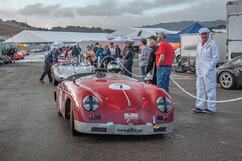

“Your 356 is a great replica, too,” the not-so-young lady zealously calls out to me. Her lips, her fingernails, her Speedster…everything about her fits together perfectly. Not only in terms of color (all red), but also in terms of authenticity (all fake).
To be on the safe side, I nod.
“Subaru engine,” she says proudly, pointing with her thumb to the back of her ruby red imposter. “Subaru, of course. Smart choice,” I kindly acknowledge. When the light turns green, the lady blows me a kiss and accelerates. Her plastic bastard with its flimsy Porsche aroma disappears, automatically shifted and in water-cooled silence. The air-cooled Speedster I’m in rolls forward leisurely. If she only knew…
Here in Malibu, California, encounters like this one are part of the road culture. People are outgoing, enthusiastic. And they drive, at least more often than anywhere else in the world, cars that match their fictional characters best: wrinkle-free replicas of legendary classics. Once in a blue moon, they might wonder if there’s a real old car behind the façade.

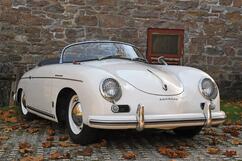
Whether the sports car I’m thwarting Malibu with is an original is relative. Certainly, it’s a real Porsche. It received all of its disputed details at its place of birth, just not at the time of its birth. Let’s put it this way: It’s the dream car Porsche would have built by 1964/65 if the frugal amateur racer’s 356 variant called the Speedster hadn’t been suspended in 1958.
This particular specimen, whose logical name is “356 C 2000 GS Carrera 2 Speedster,” was built by Porsche. In 1957. And 1976. Sound cryptic? Well, let me unscramble things a bit by telling its extraordinary tale.
On December 20, 1957, U.S. Army lieutenant Charles Smith bought a new 356A/1600 Speedster. He was based in Kaiserslautern, Germany and purchased chassis number 84285 from Rittersbacher, his local Porsche dealer. The engine put out a weak 60 hp, the paint was Meissen Blue, and the chairs were covered with red vinyl. Options included U.S. bumpers, sealed-beam headlights, a Blaupunkt Bremen radio with telescopic antenna, a tonneau cover, and a windshield-washer system.
In summer 1958, after some 3,000 miles, Smith sold 84285. The car continued to be serviced at the factory. Records show a visit to the workshop on April, 4 1964. Odometer reading: 57,671 km. Owner, location, occasion: unknown. Presumably, the car’s first life ended in a shabby barn near Stuttgart. Deposited, dusted, forgotten.

Fast forward to 1974. Hans Braun, Porsche’s head of interior styling, drives a 1960 356 Roadster, a model his friend, Wilhelm Wisdorf — a wealthy Cologne pharmacist — dreams of owning. Wisdorf asks Braun, whom he knows from his Ford Cologne days, to get him one of those rare 356s. Wisdorf’s hope: A quest in the orbit of the Porsche factory might prove more successful than one in the Rhine area.
The stylist looked for a B Roadster in papers, in Stuttgart’s neighborhood, in Porsche’s personnel files, in vain. What he eventually found was its predecessor, a 356A Speedster owned by a Porsche transmission mechanic. Light blue, red inside. Parked in a derelict greenhouse in Heilbronn. When Braun and Wisdorf inspected the car, they brought Heinz Walter, master coachbuilder of Porsche’s Werksreparaturabteilung (factory repair department).
In Walter’s judgment, the Speedster was barely restorable. Wisdorf was undeterred. 2,500 marks (some $1,000 U.S. in 1975), bought the wreck of the car Lt. Smith purchased new nearly two decades earlier. By truck 84285 traveled to Stuttgart-Zuffenhausen, back to its place of origin.
Porsche’s Werksreparaturabteilung had been established in 1950 to service and repair customer vehicles. Later, the reconditioning of engines for the exchange program was added, and shortly afterwards the maintenance of race and test cars, too. Because the department possessed experienced staff and extensive equipment including a paint shop, it was a self-sufficient factory within the factory.

By the mid-1970s, an entirely new kind of customer request was piling up: complete restoration of Porsche’s early cars. Several highlights in the factory collection had shown that the repair department, headed by classic car lover Rolf Sprenger, was the right address for restorations. Thus, Sprenger’s decision to offer official reclamation of old Porsches to a circle of well-paying clients was a mere formality.
Wisdorf would become the first customer of Porsche’s new line of business, but his demands didn’t win him favor with Sprenger. The pharmacist didn’t want a renaissance of the original condition of 1957, but rather the upgrade of his 356A Speedster to 356C generation — the final design of the primal Porsche. Sprenger advised strongly against it, but Wisdorf would not be mislead. In his view, his plan would make parts procurement far easier: While 356A panels were largely sold out, those of the 356C were still in stock.
Work began with stripping the Speedster. For the reconstruction of the understructure, panels from the 911 were used — the floors, inner sills, transmission tunnel. Using sheet metal parts of the current model resulted in a special framework “custom made by Porsche.” The exterior followed as a composition of 356C body panels, even if the passenger’s pit was left in the shape of the classic Speedster.
Something else was to be modernized: the sheet metal itself. The old 356 would get rust protection that met modern, if not futuristic, standards. Porsche had only recently published the results of its Langzeitauto research project, the “Long Life Car” capable of a 30+year lifespan. As a result, Porsche was introducing hot-dip galvanizing for all serial-production cars with the start of the 1976 model year.

Certainly, felt Sprenger, the product of the first restoration for an external customer must also be perfectly protected against rust. Therefore, the sandblasted 356’s body received a flame-spray zinc coating, done at the Leuze surface-finishing company in Stuttgart-Weilimdorf, a special treatment for the first time ever but one that has remained part of the standard repertoire of Porsche factory restorations.
Back in Zuffenhausen, the shell was repainted in a dark blue metallic. Reassembly followed, which included several details to Wisdorf’s taste. Details like a Stebro race exhaust and polished Wolfrace mag wheels. As the final highlight, the engine took its place. It was not, however, the original pushrod four with 60 hp. Instead, it was the top-of-the-356C-era legend Carrera 2 flat four with four camshafts, dual ignition, and two liters of displacement — an engine rated at 130 hp.
After a long search, Wisdorf found the capricious engine in disassembled form. He brought it to Schwäbisch Hall, where Karl Wagner — a former Porsche works racing engine mechanic and one of the few real specialists of the Carrera four-cam — had just launched his own business. Thanks to Wagner, the Wisdorf Speedster became the ultimate 356, a dream car Zuffenhausen held back from its clientele two decades earlier.
It’s no wonder that the bill climbed into the dream-car realm, too. Wisdorf paid around 80,000 Deutsche Marks for the restoration, even more than he forked out for the new, loaded 911 Turbo he took delivery of at about the same time. The Carrera 2 engine devoured another 50,000+ DM. All in, the pharmacist releases a total of some 150,000 DM — equating to nearly $60,000 in 1976. For this incredible heap of money, he could have had a Rolls-Royce Corniche, two and a half Ferrari 308 GTBs, 20 VW Golfs, or 17 Ford Mustangs on the U.S. market. Meanwhile, original Speedsters in immaculate condition were available for a tenth of that amount.

Wisdorf hit the road. Slowly, at first. He was disappointed by the four-cam 2.0’s weak power at low revs. He became bolder after experts told him the serious music came between 4500 rpm and the red light district of 7000. After a few days’ acclimatization, he would hardly get out of the car. The 356 dependably brought Wisdorf to his southern European destinations: his villa on Lake Maggiore, the Riviera, Rome.
In total, the pharmacist logged more than 20,000 kilometers in his addictive four-wheeled drug over ten years — without a single technical problem. But, by 1988, he had grown weary of his toy and sold it to well-known 356 specialist Werner Kühn in Reichshof, Bergisches Land.
Kühn viewed the four-cam engine as less than ideal for daily use, so he took it out and put it on a shelf. In its place, he installed a modified Type IV engine from a 914 2.0. With pistons and Nikasil cylinders by Oettinger, a hotter Schrick camshaft, dry-sump lubrication, and two dual Solex 40 PI carburetors, the 2138-cc flat four was claimed to offer more than 140 hp at 5800 rpm.
Kühn found the pushrod Type IV provided substantially more torque than the four-cam four, as well. It was also some 70 pounds lighter, which improved handling and sharpened straight-line precision. He noted a calming effect past 210 km/h (130 mph) on the autobahn. However, he was increasingly annoyed that again and again he had to explain the special status of his bastard at 356 meetings, an unpleasant role for a 356 professional whose clients were fanatical followers of factory originals.

On a Friday afternoon in the summer of 1991, Kühn meets in distant Würzburg an old friend from Regensburg, Bavaria. His friend arrives in his 1951 Mercedes-Benz 220 Cabriolet A and is fascinated by Kühn’s unusual Speedster. After a while, they agree on a temporary car swap, so Kühn drives home in the Mercedes.
That same evening, his phone rings. It’s his old friend. Kühn learns that he can forget about retrieving the Speedster. “I won’t ever give away this incredible car,” says the voice on the other end of the line, which belongs to Walter Röhrl. After a short deliberation, Kühn and Röhrl trade titles with no money involved. To give a rough order of magnitude: The estimated value of the Mercedes is at this time 115,000 DM, or about $65,000.
With this barter, a long-term dream of Röhrl comes true — a dream the two-time World Rallye Champion had to bury two years earlier, in 1989, when he gave another friend antecedence to buy 84285’s sister car. Sister car? Yes, absolutely. In fact, the Werksreparaturabteilung welcomed its second regular paying customer, Horst Trum of Munich, almost simultaneously with Wilhelm Wisdorf.
Just like the Cologne pharmacist, Trum took the dilapidated leftovers of a 356A Speedster in Zuffenhausen in order to get his favorite car that never existed, a 356C Speedster. But unlike Wisdorf, he chose black paint and green leather, while a 90-hp 1600-cc 912 four-cylinder would suffice. Trum drove this car, chassis number 82158, until 1989. It went through the hands of several dealers before ending up in the garage of Peter Scherbauer, also of Munich, for the sum of 140,000 DM.

For the test-drive appointment in January 1989, Scherbauer showed up accompanied by childhood friend Walter Röhrl. The latter took a courageous lap in the Speedster and decided he would take the car if his friend didn’t. Much to his chagrin, Scherbauer snapped up the car.
Röhrl and Scherbauer, who live 80 miles from one another, frequently met in their modernized Speedsters to take joint trips and participate in vintage rallies through the alps. But the seemingly carefree 914 boxer in Röhrl’s dark blue Porsche soon caused trouble: On a long-distance drive, Röhrl runs ashore with cylinder-head failure, a known trouble spot in 914 engines and even more so in Oettinger’s “big-bore” versions.
After Kühn fixed the damage, Röhrl’s Speedster had no more technical maladies. He just drove it — more often than not quickly — and enjoyed it. At least, until political animosities appeared. In January 1993, Röhrl was hired by Porsche AG as a celebrity test driver and brand representative, a job not compatible with a personal car permanently in need of explanation.
“It was a very difficult decision to sell this icon of a sports car after only 5,000 unforgettable kilometers,” sighs Röhrl today. “But it just didn’t suit my position at Porsche; I always had to apologize for the lack of the Speedster’s fidelity. Ultimately, my beloved Speedster is the only car I ever had to sell for image reasons.”

In 1994, 84285 moved back to the Rhine area and into the possession of Formula One journalist Burkhard Nuppeney in Koblenz, who paid 120,000 DM (about $72,000) for the privilege. He soon demonstrated good taste by changing some aesthetically dubious details of the Speedster: The Wolfrace wheels were swapped for steel wheels with chrome caps, the aftermarket chairs made room for Speedster seats, the sperm-colored leather was replaced with burgundy hides, and the fluffy, deep-pile carpet was supplanted by 356 “Haargarn” bouclé. Meanwhile, better noises were provided by a custom, 904-inspired stainless-steel exhaust system that cost a sinful amount.
The joy of its mighty trombone sound is brief: During Nuppeney’s very first excursion, the car stalled. Once again, cylinder head issues had rocked the boat. Werner Kühn, who still took care of 84285, recommended eliminating the sore spot. Eventually, he downgraded the Type IV back to its standard size of 2.0 liters with cast-iron cylinders. Still equipped with the Schrick cam and big carbs, the boxer four now produced around 120 horsepower.
Even if I can’t count them individually, I’m certain those 120 horses are still on board emotionally. If not more so; 84285 feels quick.
Full throttle in second…clutch…third…gas pedal back to the floor and into the curve, which the semi-modern classic traverses completely neutral, thanks to its 18-mm front anti-roll bar. No 356-like oversteer? No 356 tailspin? On this car, the old Porsche trait is passé due to the accurate suspension tuning. And, as for the somewhat home-bred Type IV motor? Well, along with the impressive thrust it delivers from idle up to the recommended limit of 6300 rpm come bold acoustics. Without a doubt, this powerplant satisfies. Deeply.

From Pacific Coast Highway, I turn into Topanga Canyon. The boxer’s roar swings between steep rock faces to become a frightening thunder. Twinkle-toed, the Speedster climbs one serpentine after another. Entering Topanga Village, I lift off the gas. Out of respect? Maybe. Here, germinated in the late 1930s and known worldwide in the hippie culture of the 1960s, lived and worked artists of all kinds. Humphrey Bogart, Dennis Hopper, Jim Morrison, Marvin Gaye — all gone, all dead. In today’s Topanga, the Lexus Hybrid-driving L.A. dropout has superseded the hashish-blessed aborigine. Let’s get out of here.
We — the Speedster and me — take a left on Old Topanga Canyon and pierce the mountains on a northwestly path. In the branches of narrow and steep streets, the limits of manageability reveal that the 356 is no rabbit-like go-kart, especially not with its bold 185/70R15 footing. Next left on Mulholland Highway, once James Dean’s training track, the curves become wider and fewer. There it is again, this 356 Speedster’s favorite subject: giant slalom.
Anyone who had a chance to perceive the evolution of the 356 through ambitious driving experiences in each of its generations and then got a taste of this remarkable car will immediately confirm my verdict: This born-again Speedster of 1976 feels in every sense like the logical, consistent further development of the primal Porsche if the evolution hadn’t ended in 1965. Yes, there’s a good pinch of 911 flavor in this car, as well as the spice of the organ donor 914. In other words: The percentage of this 356 that is genuine Porsche is three digits without a decimal point.
You may be wondering why 84285 is in California today, and not in Koblenz, Germany. Well, after his tasteful upgrade for a pile of money, Nuppeney hardly used it. In 2000, after logging less than 10,000 km in six years, he assigned Werner Kühn to sell the car.
Soon 84285, equipped with the 914 engine and the Carrera four-cam in a wooden crate, went to Bertram Pawlak, a German collector car dealer living in California. From there it made its way through an ad in the January 2001 issue of Hemming’s Motor News to current owner Bruce Milner of Santa Monica, who has continued to set up the Speedster.
Today it wears a rare and super-cool Glasspar hardtop, which the U.S. company offered starting in 1955. From early 1957, the plastic hat was distributed worldwide through Porsche dealers. Milner also added Rudge-type centerlock wheels for 13,000 Euros ($18,000 U.S.). These are very, very special: 356 experts know these optional factory rims were only available for drum-brake models. Since this car decelerates by discs, this set was custom made employing new old stock Porsche parts.
So it is that the car’s thread of individual taste, which took its start in 1976 and has passed through four owners, lives on in the Milner era. Whether equipped with the sophisticated Carrera four-cam or the mundane 914 Type IV, Milner has had to fight nasty comments from intolerant original fetishists, whereupon the term “replica” is the most gentle one. Meanwhile other knowledgeable 356 fans praise 84285 as the culmination of an evolution never realized in the 1960s.
As much as the car polarizes: In the light of its place of reincarnation and the components used, it is undoubtedly a pure-bred Porsche — a fact that today’s Porsche Classic department confirms, by the way. Being the first customer product from the factory restoration shop, 84285 also deserves a special historical status. And the 35-year-old paint job that suffered German weather conditions for almost a quarter of a century really proves the superior quality of the craftsmanship.
Then there is the great driving pleasure: Röhrl calls 84285 “the best classic touring car I ever drove.” His words mean something, since he not only bought the car but is, according to motorsport pros around the globe, “the best rally driver of all time.” Is there anyone who can think of a better compliment for an old sports car? I, personally, wouldn’t even dare to try.
Instead, I prefer to take two more left turns from Mulholland and snake through mysterious Latigo Canyon. As the evening sun sinks over Malibu, I’m back down on PCH, the legendary Highway 1 — and in traffic jams once again. Stop and go and stop and go. For the first time on my extended test drive, I’m relieved that the profane 914 pushrod boxer is installed in the only existing “Porsche 356 C 2000 GS Carrera 2 Speedster” right now. In these operating conditions, the capricious four-cam’s spark plugs would soot immediately.
On the corner of Heathercliffe Road, I enter the Arco station for gas. In the pale glow of the neon tubes, the old Porsche appears surreal. The cashier comes out, sneaks around the car, knocks on a fender, and nods knowingly: “Original Porsche Speedster. No replica.” A true connoisseur? Yes, indeed, he proudly confirms.
Then he discloses the secret of his unexpected competence: With his right hand, he shapes an extension to his ear as he says, “It’s got an air-cooled engine.”