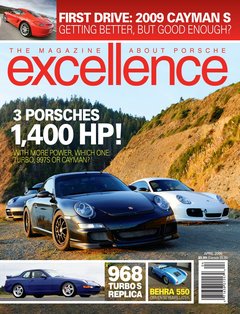
This hillbilly hauls ass. That he sees the 2006 Carrera S he drives as little more than a tool is evidenced by the fact that most of its Basalt Black panels have been repainted, the result of a few unintended bumps along his road to becoming a better driver on track.
If Jared Cullop sounds different than the average new 911 buyer, that’s because he is. When he isn’t driving his blacked-out 997S on track, he’s running his favorite back roads in the South, a legendary group of curves known as the Tail of the Dragon…on slicks. I like him already.
“The first thing you need to know about me is I’m a redneck,” chuckles Jared. “I’m not used to cars like this. Heck, where I grew up, folks are proud to have runnin’ water!” Then, in his early 20s, he was selling boats for his uncle when a customer took a liking to him. Today, he’s a partner in a medium-sized company that does design consultation, marketing, and sales for resort communities. In his spare time, Jared is into turbo-diesel pickups with 1,000+lb-ft of torque, a Datsun 240Z resto-rod, and this Porsche.
“My friends look at the sports cars and think I’m crazy,” offers Jared. “But I always liked ’em.” He’s been a fairly quick study. He can turn a 2:08 on Virginia International Raceway’s full course in his heavily modified 997S, this despite its air-conditioning, full interior, and monster sound system. Synergy Racing, the shop that set Jared’s 997S up, is sure there’s a 2:03 in the car. To put these times into perspective, Synergy Racing’s Koni Challenge 997 Carrera Ss — race cars with full cages, interior-delete, and no A/C — turn 2:05s.
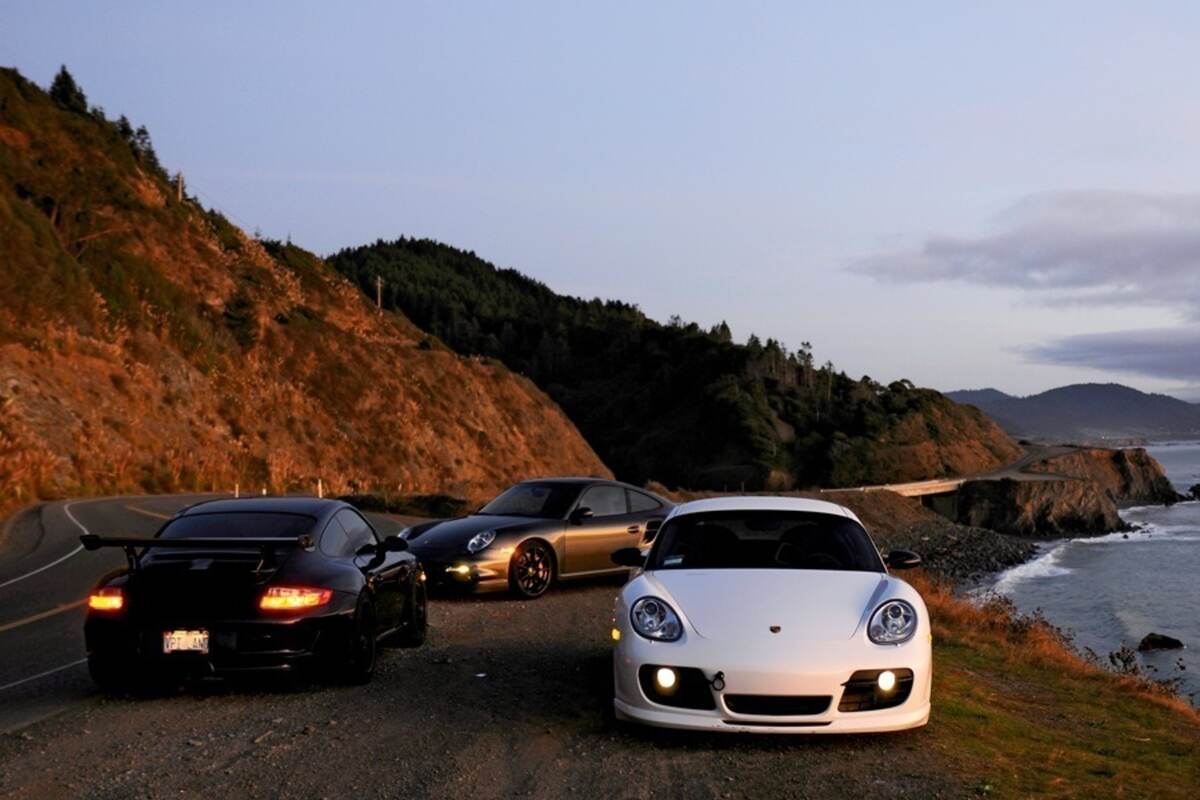
Jared has shipped his 997S to California for a road test we set up for three “non-GT” Porsches. GT2s and GT3s are nice, but Porsche doesn’t build many. So, curious to see how “regular” Porsches might benefit from aftermarket attention, we invited a modified Cayman S, Carrera S, and Turbo to a two-day comparison on our North Test Loop. With mid- and rear-engines, rear- and all-wheel-drive, and normally-aspirated, supercharged, and turbocharged flat sixes, it promised to be an interesting couple of days.
Then things went sideways. Originally, this was to be an “East Coast tuners meet West Coast roads” story, but two shops backed out — after Jared’s car was on a truck. Fortunately, finding two last-minute stand-ins wasn’t all that difficult. Bay Area tuners S Car Go Racing and SharkWerks answered the call, sending two cars that would make for a study in contrasts.

On the heavy-weight side is S Car Go’s turned-up Turbo, a 3,486-pound bruiser batting with a claimed 620 bhp and 600 lb-ft of torque — 140 bhp and 98 lb-ft more than stock — so long as it’s guzzling 100-octane premium. The added power comes courtesy of S Car Go’s aluminum intake plenum, a 997 GT3 throttle body, Blown Six intercoolers, S Car Go headers, modified VTG turbochargers, a re-baffled stock muffler with 200-cell race catalysts, and a Protomotive engine-management reflash. The engine modifications added up to $21,000; another $3,000 bought a GT3 RS flywheel and GT2 clutch pack.
S Car Go deemed the factory ceramic-composite PCCB brakes sufficient, but firmed the chassis up with Bilstein B16 Damptronic coil-overs. These work with the Turbo’s PASM system, allowing the driver to stiffen their settings at the touch of a button. ERP rear toe links with bushings, a carbon-fiber strut brace, and GT3 anti-roll bars round out the chassis mods. Installed with alignment and corner-balancing, the suspension came to $6,500. The 19-inch Dymag wheels, with carbon-fiber rims and magnesium centers, cost a cool $12,000 and shave 29 pounds of unsprung rotational mass.
On the lighter side in terms of power, extent of modifications, and pocketbook pain is SharkWerks’ RS350 Cayman S. The RS350 kit adds an EVO intake, an ipd intake plenum, a GT3 throttle body, a Cargraphic exhaust, an RSS underdrive pulley, and an EVOMSit remap. The company claims 319 bhp and 267 lb-ft at the rear wheels, or 24 more bhp and 16 more lb-ft than a stock Cayman S’s flywheel rating — suggesting more than 100 hp per liter, a heady claim. As for the kit’s price? $4,900, plus seven hours’ labor for installation.
Its power may be puny in this company, but don’t count the Cayman out. First, it weighs 2,852 pounds, or 634 less than the Turbo. Next, its mid-engined balance will be aided by Bilstein PSS-9 coil-overs, H&R anti-roll bars, and Michelin Pilot Sport Cup tires (the Turbo wears standard-issue Bridgestones). Champion’s 18-inch RG5 wheels, the Cargraphic exhaust, a $2,700 Brembo F50 front brake kit with two-piece rotors, and two $1,300 Euro GT3 buckets are said to trim 103 pounds from the curb weight. A lighter flywheel shaves 14 more, but a harness bar and harnesses add that back. Figure $5,000 for the wheels and tires plus another $4,200 for the suspension and flywheel, installed. Finally, TechArt’s front spoiler lip and side skirts, along with some artfully-placed satin black paint, lend the car a little attitude.
So it’s mid-engined, rear-drive light vs. rear-engined, AWD might. Between them is Jared’s 997S, weighing in at 3,323 pounds and packing a claimed 471 bhp and 370 lb-ft, or 116 bhp and 75 lb-ft more than stock. The kick comes courtesy of a VF Engineering supercharger kit, which exhales through GMG’s center-exit exhaust with high-flow catalysts. Synergy Racing’s light flywheel and racing clutch pack deal with the extra power and torque, while a Quaife limited-slip diff purchased from Vivid Racing distributes it more effectively to the rear tires. All told, Jared spent just over $20,000 on the engine mods, and another $7,000 on the driveline.
When Jared says every suspension piece has been replaced, he’s not far off. From GMG came Moton Clubsport coil-overs with remote reservoirs, GT3 Cup control arms, GMG adjustable anti-roll bars, GMG rear dogbones, and GMG anti-roll bar endlinks. Monoball coil-over mounts and an engine-lowering kit from Synergy Racing were also added, as was DasSport’s rear jackplate. All that added up to $13,826, while the 18×9 and 18×11.5 HRE C93 three-piece wheels with 245- and 315-mm tires added another $8,110.

Six-piston Brembo GTR front brakes with 15-inch rotors account for the lion’s share of the $4,474 spent on brake upgrades. Outside, the car wears a factory GT3 front bumper and GMG’s lightweight Kevlar GT3 rear bumper. Synergy removed the rear bumper crash system and fabricated a chromoly bar to replace it. The fiberglass RS-style rear decklid also came from GMG, as did the carbon-fiber wingtop, front-bumpertop vent, and side mirrors. Cargraphic’s front-bumper grills finish off the exterior mods, while a $4,134 pair of Cobra Suzuka carbon-fiber seats, a GMG half cage, and OMP harnesses are the most notable changes inside.
Our day starts early, but not in those Suzuka seats. Jared’s 997S has a flat. Told he couldn’t run slicks in California (“Really? Y’all can’t get away with that?”), Jared installed a set of Pilot Sport Cups before shipping his car. No Michelins are available locally today, but S Car Go says it can mount four Toyo R888s this morning.
As three flat sixes fire up in cold, early morning darkness, we formulate Plan C. Yes, Plan C, because there’s more drama to deal with. The Cayman’s harness bar is pinching the seatbelts’ retractors, rendering them unsafe — and a seatbelt bolt is stripped. So, as Jared heads south, Bob Chapman and I head north to pick up our fourth driver, Steve de Jung, at his shop. Besides knowing our Loop intimately, Steve is an able wrench, which comes in handy at times like these. As he solves the Cayman’s safety snafu, a flurry of phone calls reveal that Jared is stuck in nasty Monday morning traffic on the way to S Car Go. So are the Toyos, somewhere…
With the Cayman sorted, Bob, Steve, and I head for the coast and first photos, hopeful Jared will catch up not long after. The bet pays off. Two hours and a lazy lunch later, Bob is pulling his camera gear out along a darkened redwood road when we hear a flat six ripping through tall trees. It sounds like a Cup car. The three of us let out a cheer as Jared flies past, lights up his brakes, and turns around.
First photos done, I start the day in the hillbilly’s creation. Jared isn’t too tall, so his fixed-height Cobra seat puts the head atop my long torso too high. But what a seat; you’ll go nowhere and like it. The thin-rimmed stock steering wheel remains, but its multi-function buttons don’t work with all of the gadgets on board. Traqmate data acquisition, Chase Cams, laser/radar detectors, iPod adapters, MRI machines, blinking lights, squawking gizmos, a Rocky and Bullwinkle panel where a visor should be…you name it, it’s in here. I just want to drive, so I ignore all that and twist the ignition key, snick the factory short-shifter into first, and move out.
In every way, it’s an extreme 911. Once up to speed, it feels noisy, alive, nervous. The 3.8 is loud, but backs up the bark with plenty of bite. The added thrust is nice, but the more pleasing difference between this car and a stock 997S is the way it makes its power. The supercharger fills in the low-end torque curve and helps breathing in the upper reaches. Unlike the stock 3.8S, it pulls past 7000 rpm with abandon. Gear after gear, the acceleration is impressive, the reach to redline rewarding. It’s easily the fastest narrow-body 997 I’ve tested. 400+ horses at the rear wheels? Yeah, I believe it.

The flat six isn’t this 997S’s bright spot, though. The chassis is. While not immediately confidence-inspiring, it turns in beautifully and rotates into plenty of mechanical grip. The 15-inch Brembos are noisy but stupendous, easily washing off speed between curves before the confidence to carry more speed through them comes. As the minutes and miles pass, it does. Work the tires up to temperature and the car gels, encouraging you to probe the edge of its rear-end adhesion before showing you even more grip. Jared calls Toyo’s R888s “edge-seeking,” and he’s exactly right.
Keeping the Toyos in contact with the Loop’s mix of varied surfaces is the job of Moton’s highly adjustable coil-over dampers. We’ve liked these shocks for some time, but Synergy Racing’s setup demonstrates just how good they can be. The settings for compression and rebound are a home run, providing that oft-sought but rarely achieved mix of minimal body roll and a distinct lack of bobbing over bad surfaces. The result is a stiff 911 that actually rides well, its tires following the pavement beautifully — ensuring traction and building driver confidence, too.
The chassis talks to you, telegraphing its every move through the steering wheel’s thin rim and the seat’s deeply bolstered basin. All the marks of a brilliant setup are here. The nervousness initially perceived is the edge that makes this a 911 more neutral than it has any right to be. The front end feels like it’s got weight on it and requires less trailbraking to load the tires for turn-in. Often, a lift is all you need. Through the curve, side-loading builds progressively. Back on the gas, rear-end grip is reassuring without removing the ability to alter your angle on throttle, something easier to do here than in a GT3 thanks to the 3.8’s supercharged torque.
Time to change cars. Jared, fresh from the Cayman, is waving his arms and jabbering at Steve and Bob. Wanting to form first opinions on my own, I make for the Turbo. Its cabin couldn’t be more different than the S. Nomex chairs and gizmos give way to power-everything thrones and a hushed cabin bathed in Natural Brown leather. In case you’re wondering, you do want that optional leather-covered sunroof-control surround. The stitching looks like Ferragamo’s, not a car company’s.
The sumptuous interior is fitting. Where the 997S screams “I’ve been modified — help me!,” a Weissach engineer wouldn’t know a cook’s been in this kitchen. Until he stands on the gas, that is. Then comes the flood of boost. When the twin turbos blow, this 997 Turbo blurs the scenery in a way even the new GT2 can’t match. Its power is epic, the fact it still feels so “factory” deeply impressive. The engine mods create a uniquely sudden yet silky wave of torque, the likes of which we’ve never felt in another Porsche. We started off on 100-octane fuel, but the car’s pace suffers little on California’s weak 91 unleaded. It is, quite simply, a rocket. As with a stock 997 Turbo, though, turbo lag is considerable, Variable Turbine Geometry or no.
Fortunately, the sudden acceleration is checked by ceramic-composite PCCBs. These factory brakes are easily the equal of the Brembo GTRs on the black car, this despite the Turbo’s added 163 pounds. If that gap sounds too small to you, remember the Turbo’s lightweight brakes and wheels as well as the 997S’s supercharger, half cage, and slew of electronics. But it’s the Turbo where you really feel the bulk. The harder you press, the more you must manage its weight and think your way into turns, then execute the line least likely to overwhelm its outside front tire. Too often, you end up feeling sorry for the poor 235…

On the bright side, the Bilstein B16s cancel much of the stock car’s excessive dive under braking, roll in corners, and squat under acceleration. We’re no longer tempted to select the Sport shock setting to help cancel all of the above, then grin and bear the ride. While stiffer, the B16s keep the car relatively flat and predictable while soaking up bumps better, with less bobbing. They offer useful valving in both the Normal and Sport settings, the difference between them being far less distinct. Though rough sections still call for Normal, Sport is now useful on real-world roads.
As is, though, the car simply isn’t sharp enough. Besides the inescapable sense of bulk, there’s too much understeer to contend with and too little willingness to change direction. Rob King, who tuned the car to meet a customer’s daily needs, wanted to mount R-compound tires going into this test. Doubtless, they would have helped, because the car is always on the edge of traction when pushed. But Champion Motorsport’s Werks K1 (Excellence May, 2008) showed us that more extensive suspension modifications can hide most of the 997 Turbo’s bulk and take its handling to GT3 and GT2 levels.
This 997 Turbo more than gets the job done, but leaves us cold. It’s seriously fast, but fails to offer the involvement we crave. You can’t escape the feeling that computers are at work. Hard at work. If you manage the weight well and trust the car’s computers, the speed on tap is stupendous. But, on these roads, it’s an impressive car rather than an involving one.
Time for the Cayman, then. There’s a deceptive simplicity to this car — it does more with less than either of the 911s and challenges both in terms of satisfaction. Straightaway, its true two-seat cabin feels more intimate. It’s not so much the lack of back seats as it is the flat six spinning just inches behind you. You get more of its mechanical signature and intake howl, a good thing because M97 3.4s spin more eagerly than the M97 3.2s and 3.8s. This one is no exception; its EVOMSit reprogramming feels like a factory job in refinement terms and, with it, the RS350 kit creates a 3.4 that still relishes repeated trips to the redline. While we can’t say we feel an extra 40-50 horses, the RS350 does feel stronger than a stock S.
The Cayman may be the least powerful car here, but its reassuring chassis lets you use more of it, sooner. Turn-in is keener than even the 997S’s while rear-end traction out of turns — if not 911 good — is still considerable. The Cayman feels like what it is: an inherently neutral sports car rather than one tweaked to get there.
Its balance and willingness to let you make minor mid-corner adjustments set it apart from other mid-engine Porsches, 914 and Carrera GT included. It’s Boxster easy, but far more focused. That makes the RS350 one of the best modern Porsches we’ve driven on the loop, and the best 987. Up to seven-tenths it’s simply brilliant, flowing down the road with a rhythm hard to obtain in the 997s. It’s a momentum car that happens to have just enough power and great brakes. Maybe that’s why it always keeps pace with the far more powerful 997S and 997 Turbo. But it’s more pure fun than either.

Press harder, though, and it’s not long before the inside rear tire loses traction on the way out of tighter turns. In fact, any second-gear bend exiting uphill results in wheelspin — which prompts the PSM stability management to cut power. Eventually, we turn PSM off and manage the wheelspin with our right foot, an improvement but hardly the way to go. So, yes, the Cayman does want for a limited-slip diff. But there’s another problem, too.
While the 18-inch R-compound rubber was a brilliant call, the Cayman’s Bilstein PSS-9 dampers are no match for Motons. The PSS-9s don’t allow rebound-damping alterations without compression-damping alterations — a disadvantage against the independently adjustable Motons. There is a $3,000 price gap between them, but we feel the delta is justified. With better dampers, the Cayman might move from merely one of the best-handling Porsches we’ve tested on the Loop to top dog. Don’t get us wrong: the majority of enthusiasts who want to lower their Porsches and gain performance while doing it will love the PSS-9s. And, while the last 10-20 percent in damping goodness to be had with Motons is appealing, we’d spend our money on a limited-slip diff first.
It’s dark when we stop for dinner and discussion. So what’s Jared’s take on the Loop? “I see why you test cars here, but I don’t know why Californians don’t just get a big ol’ road iron and straighten them out.” Steve and I share a puzzled smile, then ask what a road iron is. “A steamroller!” responds Jared with a toothy grin. Clearly, the guy doesn’t know about earthquakes and California’s notoriously bad drainage. He did, however, notice something else: “Even the smoothest sections have porous surfaces to deal with rain. Our corners are heavily banked for drainage, so the grain is tighter, giving you a lot more grip.”
As for the cars, a book could be written on subtleties observed over 600 miles. Like the fact that re-baffling the Turbo’s muffler creates a more entertaining, more appropriate exhaust note — and that its clutch assist works well with an RS clutch and flywheel. Or that the 997S had the best short-shifter, even though several similar factory units have disappointed us. As ever, adjustment is key.
But, when it comes to the total experience, the driving, the white RS350 comes up big. I wasn’t alone in noticing the wee coupe was always in the mix, no matter who was driving. Jared wonders aloud what might have been had he started with a Cayman S rather than a Carrera S. He can’t get over the mid-engined chassis’ balance: “That little croc is even better balanced than my 911! How much do used Caymans go for?” When we tell him $35,000 with miles, all day long, his eyebrows rise. “Are you joking? I’d rather have that and one testicle than a new 350Z!”
The rest of us love the Cayman for its balance and undiluted fun, too — though all four of us agree the more powerful 911s would leave it behind on a race track. But, here, on real-world back roads, it’s got all the speed you need — an amazing feat considering the money involved. It’s the only sub-six-figure car in this test, and a savvy enthusiast buying used might build a copy for under $60,000.

So what about the 911s? Steve is impressed by the Turbo’s seamless integration. He has a point; the Turbo is the only car that feels like a factory car, and the only one that has zero failures over two days. Even its tire pressures were perfect, and it was picked up on 24-hour notice from its owner, not S Car Go. The Cayman’s power-steering pump eventually started to groan due to a leaky fitting, a known failure in hard-tracked 987s, while the 997S’s forward HREs got so hot they let go of their center caps. Niggles, maybe, but niggles that remind us of two golden rules: shop the aftermarket wisely and pick vendors who will help if niggles crop up. HRE did, offering to send new, custom center caps.
Bob loves the Turbo’s thrust, and names it the car he’d pick, but only to live with day in, day out. I can see why. It’s one of those rare aftermarket cars that doesn’t feel like one. But its chassis could do to feel a little less factory, because the current Turbo is just too soft, too uninvolving. “Man, it’s like Porsche lit steering feel on fire and threw it out the window!” opines Jared. “Do they all drive like that?” Sadly, Jared, they do.
So it’s a straight fight between the 997S and the Cayman S. Raw thrills and addictive speed versus scalpel-sharp handling and pure, undiluted fun. It’s a hard pick. The Cayman has held its head far higher than expected given its credentials. It’s the mildest car and the most accessible. But, pushed hard, the RS350 is scintillating. Just as a Porsche should be.
Trouble is, Jared’s 997S is more scintillating. It’s an incredible car, a furious 911 so different than the Carrera S it started life as. It’s the rarest of modified cars: one that gels. This is a four-wheeled hurricane of a car — raw, immediate, lightning quick. It’s also one of the best leaned-on Porsches I’ve driven, deeply addictive for its adrenaline rush and handling highs.
So the 997S wins by a nose. Or, rather, a limited-slip diff. The Cayman may have the best platform, but a spinning inside rear is its Achilles’ heel when the chips are down. Fortunately, that’s a relatively easy fix. The next upgrade would be better dampers, Motons or similar. A Cayman with this 997S’s setup brilliance might add up to our favorite Porsche chassis of all time. Then, and only then, we’d start to think about more power. For his part, Bob’s certain such a Cayman would have been enough to win. He should know, having driven Farnbacher Loles’ 3.8-liter Cayman GTR (Excellence September, 2006) with its limited-slip diff and extensive suspension tweaks, a car that could still be built for less than what Jared’s got in his 997S. In fairness to 997 Turbos everywhere, time on the Loop in Werks’ K1 tells me it would have been a real contender. But now we’re dealing with what might have been rather than what is.
No, on this day, the least powerful car grabs a moral victory while the most powerful trails. Where the Cayman and Turbo feel like sharper versions of their former selves, the 997S is a car transformed. It demonstrates, once more, that the 911 can be tweaked to yield incredible performance and an all-consuming experience, too. This Carrera S shows there is enough potential in every 997 to answer a challenge from the world’s best engineers, Porsche’s included. So, is it GT3 good? Time to turn a page and find out…