
In garages and race shops around the world, engines are being reunited with famous chassis. Gear oil is being changed, centerlock lug nuts swapped for tie-down lugs — all for one big race weekend along the Central California coast. As “The Weekend” approaches, my mind wanders to last year’s Monterey Historics.
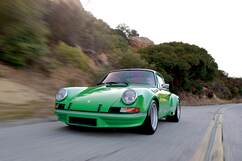
I remember walking up to the bright green FotoQuelle RSR sitting in front of its trailer, knowing I wouldn’t be watching it this time. I can still hear its flat six and gears grumble behind me, still smell exhaust fumes laced with race gas as I follow another RSR through a paddock jam-packed with race fans. I can see their eyes peering into each car, straining to spot a famous driver. It’s not a memory you’d forget, either.
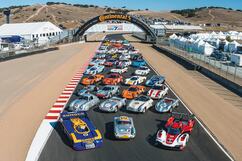
This year, tens of thousands will flock to an event they’ll still likely refer to as “the Historics.” What they’ll get is something different to the 36 annual gatherings executed by Steve Earle, who started the Monterey Historic Automobile Races for the right reason: to gather friends and enjoy some track time. Originally meant to buttress a little old-car assembly known as the Pebble Beach Concours d’Elegance, Earle’s side show in motion grew into the 400-car anchor of a ten-day automotive extravaganza featuring seven concours, eight auctions, four drives, multiple memorabilia shows, and countless private parties.
Under the direction of SCRAMP — the body managing Mazda Raceway at Laguna Seca — the 2010 Rolex Monterey Motorsports Reunion will feature 640 cars. What was already big is about to get even bigger.
For me, “The Week” had already gotten to be a bit much. More years than not, I’d get my Weekend in the weekend before, at a well-kept secret called the Pre-Historics. Held at Laguna one week before the Historics, it featured most of the cars but none of the crowds. I’d hit a few weekday shows and then, come The Weekend, celebrate the car somewhere far north — on backroads quieter than San Francisco’s financial district on Christmas Day.
There would be no getting out of The Weekend in 2009, though. Porsche was the featured marque at Earle’s final Monterey Historics, and it wasn’t long after I learned about it that I got a call from a familiar and grumbly voice. “Want to drive an RSR at the Historics?” The voice didn’t bother introducing itself, but I knew it was Kerry Morse. “Yes…,” I said — only to hear click.

A few weeks later, at the Pre-Historics, I shake hands with Arizonan Jim Edwards, owner of the FotoQuelle RSR. Tall with wild, woolly white hair, he’s the trackside T-shirt and shorts alternative to paddock collars and khakis. Next to his trailer, a pair of too-tall mannequins in ex-Hurley Haywood driving suits make it plain he’s into vintage racing for one reason: to have fun. There’s nothing casual about the focus of his clear blue eyes, however, nor the cars he’s got parked out front: The Last 935, the Burton 934, and two Carrera RSR 3.0s.
The RSR I’ll be driving is 911 460 9060, a car I’ve known since I was in high school. Back then, Larry and Jan Grove brought it to various events in Northern California where, more often than not, it was in close proximity to 911 460 9073, the Jägermeister RSR. The cars have been something of an item for decades, having left Germany for Hong Kong together in 1980 after extensive competition careers in Germany. They left China together, too, destined for a third life on America’s left coast.
Built in April 1974 and painted bright green, 9060 was equipped with engine 684 0083, a 3.0-liter, 330-hp six with slide-valve injection. It was delivered to Autohaus Max Moritz, which hired Reinhard Stenzel to drive it with FotoQuelle sponsorship from 1974 through 1976. 9060 would take eleven wins, seven of them coming at Hockenheim. When Max Moritz sold 9060 to Rolf Göring in June 1977, it was wearing Group 5 bodywork with a 935-like nose. Göring took 9060 hillclimbing in 1977 and put it on the podium every time but once, taking eight overall wins, four seconds, a third, a class win, and two seconds in class.
Göring then sold 9060 to Willi Bartels in March 1978, who returned it to Group 4 specs and went hillclimbing with sponsorship from Warsteiner. He managed four wins, three seconds, and a fourth. In 1979, he gave 9060 its best year, taking nine wins (including one at an ADAC race at the Nürburgring). In 1980, 9060 was sold to new owners in Hong Kong. There, it ran in Viceroy livery alongside 911 460 9073. The pair of ex-Autohaus Max Moritz RSRs finished well at the Grand Prix of Macau, in second (9073) and third (9060).
Californian John Byrne discovered the pair of Porsches in 1985, recognizing them as RSRs not by what they looked like but by their serial numbers. After hiring a member of a Hong Kong car club to act as his agent, Byrne negotiated a deal: He’d get 9073 while 9060 would go to friends and fellow Bay Area residents Larry and Jan Grove. When the cars arrived stateside in a 40-foot container, they looked more like 935s than RSRs. The trio of Porsche nuts quickly began their research for the extensive restorations that lay ahead.
In the meantime, the Groves used 9060 at track events. Larry remembers it as a big step up from their 914-6. “There weren’t any straights at Sears Point anymore,” he says. “We thought we’d been going fast in the 914, only to learn we really hadn’t been.” The couple continued to track 9060 as they researched its history. Though the car was white, light green specks here and there had Byrne convinced 9060 was the FotoQuelle RSR on the August 1974 cover of Christophorus, Porsche’s own magazine.

“John was more sure than I was,” Larry says. However, the Groves’ extensive research would prove Byrne right. Their commitment to the project prompted them to learn German and visit Europe several times. In a thick, beautifully organized binder, letters to and from Porsche’s Jürgen Barth, historian John Starkey, Reinhard Stenzel, Eberhard Strähle (the man who shot the Christophorus cover), and others confirm 9060 as the FotoQuelle RSR.
When the Groves finally took 9060 apart in 1989, they found almost no structural damage. It had, however, lived on like most race cars, as an evolution of performance. Larry says the biggest challenge was figuring out what belonged on 9060 and what didn’t. While information from Germany was helpful, videos Byrne and the Groves made of other RSR 3.0s were the key. Kerry Morse supplied many new-old-stock RSR parts along with quite a few he made. Jim Breazeale at European Auto Salvage Yard in nearby Emeryville was a big help, too, as he recognized the importance of the cars and loosed parts from his personal stash.
The restoration of 9060 was completed by 1991, and the Groves campaigned it for 15 years. They may never have sold it, but a health issue brought them to a decision. “After 21 years with the car, it was time,” says Larry. What they would not do, what they could not do, was simply sell 9060 to the highest bidder — it had to go to someone who would use, enjoy, and share it.
Jim Edwards was the buyer they chose in June 2006, and he’s kept his promise. More often than not, 9060 can be found in the paddock alongside 9073, as Byrne and Edwards are friends. It’s clear that Edwards enjoys driving his cars, but he also respects their histories and wants to share them. “I remember being on the other side of the fence, and now here I am,” Edwards says flatly. “And besides, if you can’t have fun with these cars, there’s no reason to keep them.”
After trying the driver’s seat of 9060 on, I head over to check in with the General Racing folks. When my racing license (provisional) and medical (suspiciously devoid of heart failure) fail to pass muster, I’m sent straight to the top: Steve Earle. After all that I’ve heard about him — from “he hates Porsches” to “any contact and you’re out” (verified) — I’m expecting a stern face. Instead, I find a kind one.
Earle cracks an easy smile as he looks over my paperwork. “I don’t know why you had trouble,” he says. “It even says that a racing license isn’t required on our website. All those do is tell me you have minimum aptitude. I am not looking for minimum aptitude — I am looking for good judgement. You do have that, don’t you?”

I’m not quite sure what to make of an organizer who runs his races on common sense, or what to make of such a friendly exchange after so many intimidating ones with other officials. As I’m heading for the door, Earle speaks again: “Oh, and by the way, we’re subscribers — have been for a long time.” Hates Porsches, eh?
If you’re like me, the idea of actually driving a real 1974 Carrera RSR is intimidating. Racing one, even more so. In shape and era, it’s a 911 not so distant from Porsche’s famously wayward 930. Oh, and it’s a race car, a car meant for racing drivers. Words like “serious” and “unforgiving” come to mind, not “docile” or “easy.”
“Familiar” is the first word that comes to mind as I trundle through the paddock. Despite its impossibly wide slicks and full-race flat six, this RSR feels like a $600,000 SC. It starts with the same key that my old, $16,000 911 did. Four of the five gauges in every 1970s 911 are present, though one key difference is a 10 on the tach. The carpeted dashtop and on/off clutch are two more.
On track, series production 911 vibes take over again: the great visibility, the solidity, the so-so 915 shifter. With some heat in its tires, 9060 feels like a Spec 911 with more grip. A lot more. If you know how to handle an early 911, then you know how to handle a ’74 RSR. In fact, it’s easier. With far more grip than power, it feels honest, like a 911 that will never put a foot wrong, that will never surprise you.
Even so, I decide to follow Byrne in 9073 to see what I might learn. The lesson is shortened when something I was worried about comes up in my mirror: Faster traffic in the form of turbocharged 935s and 5.8-liter Dekon Monzas. As they filter through, Byrne gets away.
Which leads me to another surprise: Out here, a 330-hp, 2,100~pound 911 can feel, well, kinda slow. Other RSRs are walking me on the straights, but that’s because 9060 is that rarest thing in vintage racing: a 3.0-liter RSR with a 3.0-liter engine (as well as its original curb weight, suspension pick-up points, etc.).

9060’s 3.0 was just freshened by Jerry Woods, so I know that it’s healthy — but the car’s power-to-weight ratio suggests something more exciting than the reality. Maybe I’ve been ruined by 500+hp street cars, but 9060 feels on track like a Boxster S does on the street. Of course, there’s “feels fast” and “is fast.” Tested in the February 1975 issue of Sport Auto, 9060 did 0-62 mph in a still-impressive 4.2 seconds.
Even so, coming off the super-slow Turn 11 and onto the front straight, there’s time to check my watch, check the gauges, consider a new world view, and check my mirrors before heading up the hill. Whenever I see a 935 rounding Turn 11 way, way back there, I leave some space because I know it’ll beat me to Turn 2. It’s an awesome thing to be passed by a fire-spitting 935 at over 100 mph. 9060 can keep pace with its younger, turbocharged brothers into the tight Turn 2, but the ’35s plain disappear after that.
Despite wild speed differentials, the first session feels safe, like a well-run track day. I spend most of my time running solo and, when I’m not, even the hardest chargers are courteous. The same holds true in the race; the fast part of the grid disappears, only to lap the field smartly towards the end of the race. If this is what the big show — the one people pay to see — will be like, I can’t wait.
Six days later, at Friday practice for the Historics, the big crowds change everything. The drive from paddock to pit lane is hectic, requiring care so as not to run over fans who can’t hear your engine, loud as it is, over all the others. Stewards’ whistles help, but only so much.
Things are different out on track, too. While Group 7B is largely the same as last weekend, it’s got an entirely different temperament. I feel like I’m back in one of Jay Lamm’s first LeMons races, only the cars aren’t $500 beaters. Until now, I was feeling pretty comfortable with this whole endeavor. At the Pre-Historics, everyone was polite. Now drivers are dive-bombing on the way into Turns 2, 3, 4, 5, 6….
I watch a pack of Porsches and Corvettes swarm around a Ferrari 512BBLM that’s holding them up on the way up the hill to the Corkscrew, which happens to be blind. It’s Steve Earle’s last weekend as the Sheriff, and a few hooligans are acting like it. I back off, thinking if this is practice…

I decide to use the session to work on the one thing I couldn’t get comfortable with last weekend: going flat over the high-speed blind kink that is Turn 1. It’s one thing to do so in a modern car with ABS, something else entirely in someone else’s 1974 RSR.
Fellow Dutchman and occasional coach Kees Nierop’s trackside advice (“Don’t worry about getting slowed down and the downshifts, just keep both hands on the wheel and your right foot flat. You’ll have the time you need.”) unlocks the door, and the thrill of going flat over the hill is exceeded only by my admiration for the RSR’s braking, with its 917 calipers and wide, sticky slicks.
The ease of use, the grip over power, and the confidence inspired by 9060 reminds me of another RSR I’ve driven — one that raced at the 24 Hours of Le Mans in 2007. As in that 997, you turn in and there’s no need to wait for the slicks to key into the pavement, because they already are. There’s even more grip out back, which makes putting the power down easy. Those fat rears will take all the torque the 3.0 can give.
Back in the paddock, signs of on-track aggression can be seen. One RSR’s fender is being taped over, a move that won’t prevent its driver from being tossed out of the race for making contact with another car. At our trailer, things are heating up for different reasons. David Donohue is climbing out of Edwards’ 934 — and the crowds watch him pull his sweaty helmet off to reveal a big smile. I dive into the trailer, trying to focus on just one thing: how I’ll keep the perfectly patinated 9060 in one nice, big piece.
Sunday’s lunch break presents an unexpected opportunity — a chance to take my father around Laguna Seca. The man who sternly taught me to feel the clutch in a 1964 VW bus, the man who views Porsches as “dishonest Volkswagens,” reluctantly allows me to strap him into the RSR’s flimsy passenger seat. Minutes later, up the hill from Turn 6, I can tell that the engineer in him admires the song of slide-valve injection and six horizontally-opposed chambers. The rest of him probably wonders what, exactly, he helped my mother create in 1973.
Group 7B is the last race of the day. Whistle-blowing stewards wave me past chain-link gates and onto the pre-grid, then help me back 9060 in at an angle. To my right, Porsche Motorsport legend Jürgen Barth is pulling his balaclava on. He’s sitting, door open, in an RSR 3.0 much like the FotoQuelle car only blue with white-stitched Wally’s Jeans livery. Behind me, somewhere, Hurley Haywood is sitting on the same grid in his Brumos 935.

As stewards give the two-fingered two-minute warning, the moment isn’t lost on me. Such moments, when you realize you’re a long way from what you once knew, only come along every so often. In my case, it’s a long way from driving my 914 to the Historics to watch Juan Manuel Fangio and Phil Hill cane famous cars. Framed by the RSR’s windshield, tall flags along the pit wall are flapping. On them, familiar red-boxed “O”s, one each in Monterey and Historics, are flying for the last time at Laguna.
When I hear a long whistle, it’s time to let the clutch out. I follow Barth out watching rocks shoot off his slicks. Entering the course between Turns 1 and 2, 330 horses chuntering behind me finally get what they want: to go. People line the fences, and I can see the 935s of Haywood and Bruce Canepa behind me on the warmup lap, waiting to pounce when the green flag drops.
That’s just what they do, their 935s slicing through the field and passing RSRs as if they’ve got roughly double the power. Which they do. They’re chasing the black 1979 935 of fast Australian Rusty French, but they won’t catch him this day.
I latch onto a longhood RSR with Peter Gregg bodywork and Viceroy livery. It’s running a bit faster than I have thus far, but it’s a pace I can match on the way up to the Corkscrew and back down the hill. Up the front straight, I follow it over the blind crest at over 100 mph. I discover a problem over the rise: Its driver lifted! It’s a full-pucker moment, a balance between braking too little (and rear-ending him) and braking too much (and losing the rear end). Fortunately, the RSR makes the job easier than it looks, and I follow the Viceroy 911 for another lap. I can tell I’m faster — but not enough so to risk a pass on the hill.
When we round Turn 11, I’m ready and hear the sound unlike any other: two cars at wide-open throttle. With the blare of two RSRs reflected off the pit wall, FotoQuelle is just pulling Viceroy as we head up the hill. Then, sure enough, he lifts. His longhood disappears from my peripheral vision, only to reappear in my rearview. It stays there for two corners, then fades from view.
Haywood passes me at one point only to dive into the pits two turns later, the victim of a broken fiberglass seat. 7B is a race of attrition considering its brevity, with another 935 dead at pit-out and four cars failing to finish. At the sharp end, the black and white 935s of French and Canepa leave the red Monza of Chad Raynal in third. But, in my book, the best drive is the one authored by Mark Hotchkis in his RSR-ish 1973 911. With no turbocharger, he’ll finish seventh overall, ahead of several 935s and Bowtie brawlers, nine spots in front of the next normally-aspirated 911.
If 9060 leaves a dominant impression, it’s that turbocharged RSRs — the 934 and 935 — were the inevitable evolutions, so thoroughly had Porsche licked the 911’s handling by 1974. It’s something Edwards agrees with, and something that prompts us to lay some plans…
As the crowds head for Highway 68, there’s plenty to take down and even more to load up. But first, nature calls. On my way back, I spot Chuck Forge loading a famous 356 onto a rusty open trailer, in stark contrast to the massive, ex-Indycar transporters littered across the paddock.
Small, red, and achingly straight, 356/2-063 is beautifully prepared, and rightly so. Southern California’s John von Neumann had the top chopped off this Gmünd coupe in 1952 to reduce weight and frontal area, making it the car to beat in Under 1500-cc competition. Forge bought 063 in 1957, drove it on the street for ten years, and then parked it. In 1980, Forge’s first trip to the Monterey Historics inspired him to restore 063 in time for 1982’s big weekend. He’s been a fixture at Earle’s circus ever since.
It’s another Porsche I’ve known from a distance for a long time. When I ask Forge if he’d show his car to me, a smile stretches across his 74-year-old face. He tells me to hop in, and I can’t believe how simple the door is…how simple everything is. As he takes me through 063, noting what makes it hard to drive as well as what he loves about it, I sense the time he’s spending with me is time he’d spend with anyone willing to listen. However, it is time made more special by a bond I’ve never known here: the one between two drivers in the paddock at the end of a race weekend.
I’ve got to get back to our trailer, so we part ways with an agreement to meet for lunch sometime in the fall. It’s a sometime that would never come, because Forge died in his sleep just thirteen days later. Looking back nearly a year later, at all that happened at my first Historics behind the wheel, I’m grateful for those minutes with Forge and his 356 in the last light of the last day — because the man and machine were the embodiment of all that Earle intended.