|
HIDEOUSLY FAST
CALL IT GERMANY'S MOSLER CONSULIER IF YOU WILL, BUT 9ff's GT9 IS FASTER THAN A BUGATTI VEYRON
STORY AND PHOTOS BY IAN KUAH
Ambition is one of humankind’s great strengths. If not for ambition, people never would have got off of the ground, walked on the moon, or explored the bottom of the oceans. Every human ambition starts with a dream.
For German tuners, the dream might be setting a new lap record at the Nür-burgring. Or winning the Sport Auto Tuner Grand Prix. But, for engineer Jan Fatt-hauer, whose working knowledge of ultra-high-speed road cars was gained at Ruf and Brabus, the 400-km/h barrier was a tantalizing objective that soon became an obsession. After 25 years in the industry, I have seldom met anyone who puts in as many working hours as Jan. When he has a speed record in the offing, his sleep quota drops dramatically and he thrives on the buzz and adrenaline highs generated by the tightly knit team which works tirelessly around him.
I’ve witnessed his cars break through successive speed records at Nardo and driven the cars that have achieved these records. Each has been significantly more powerful than its predecessor —and even scarier as a result. In 2004, the 743-bhp 9ff 9F-T6 reached 232.7 mph. The following year, the 840-bhp 9F-V400 blasted through the traps at Nardo carrying an average speed of 242.5 mph. Even for someone who has seen 208 mph, these are seriously big numbers.
When you look at these figures on a sheet of paper, Fatthauer’s last record of 242.5 mph (388 km/h) does not seem that far away from 400 km/h. But one of the immutable laws of physics is that drag increases with the square of speed. That means the faster you go, the more power you need to gain the same increment in speed. Another problem is that the faster a car travels, the more downforce it will need to keep from aviating. The necessary aerodynamic aids and spoilers create additional drag that eats up yet more power. This is the reason why F1 cars have relatively low top speeds.
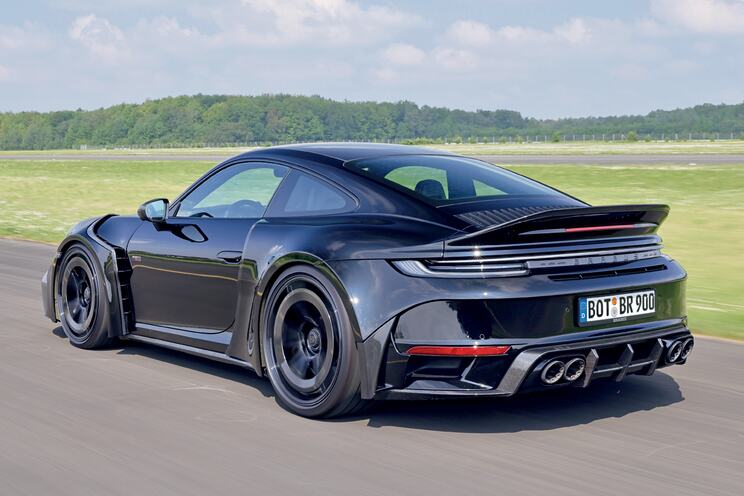
A road car capable of 250+ mph is no small ambition, but Fatthauer got his wish in April, 2008. His 987-bhp GT9 achieved 408.77 km/h — or 254 mph — at the Papen-burg high-speed test track in Northern Germany. The car that took his team over two years and hundreds of hours to build had justified itself. Just a couple of weeks before setting the record, 9ff took it on a European tour for the press, which was a major undertaking in itself. The first stop was England, where the GT9 blasted down former military runways and test tracks in the hands of journalists eager to prove it was indeed as fast as claimed.
From England, the GT9 returned to continental Europe for a lifestyle shoot by a prominent French tuning magazine. But Northern Europe in late March is not the best time of year to be driving powerful cars, and, true to form, the weather in France was just as dismal as in England. By the time the GT9 made its last port of call in Southern Spain for our track test at the picturesque Ascari Race Resort, the 9ff team had just about had it with rain and wind. The weather was not brilliant when they arrived in Marbella, but it soon returned to normal for the time of year and we were blessed with gorgeous sunshine in Ronda for our testing.
Why track test a car meant to go hell for leather in a straight line? Because every other magazine wanted to go hell for leather in a straight line and because Fatthauer told us his mid-engined GT9 can hold its own against a 997 GT3 in a slalom course thanks to its mid-engined balance and multi-link rear suspension with race-style horizontal dampers. Thus, I figured it should be reasonably good around a track — and good fun trying to put 987-bhp and 710 lb-ft of torque down through just two contact patches.
|