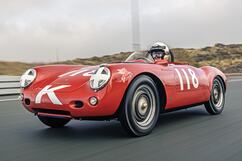
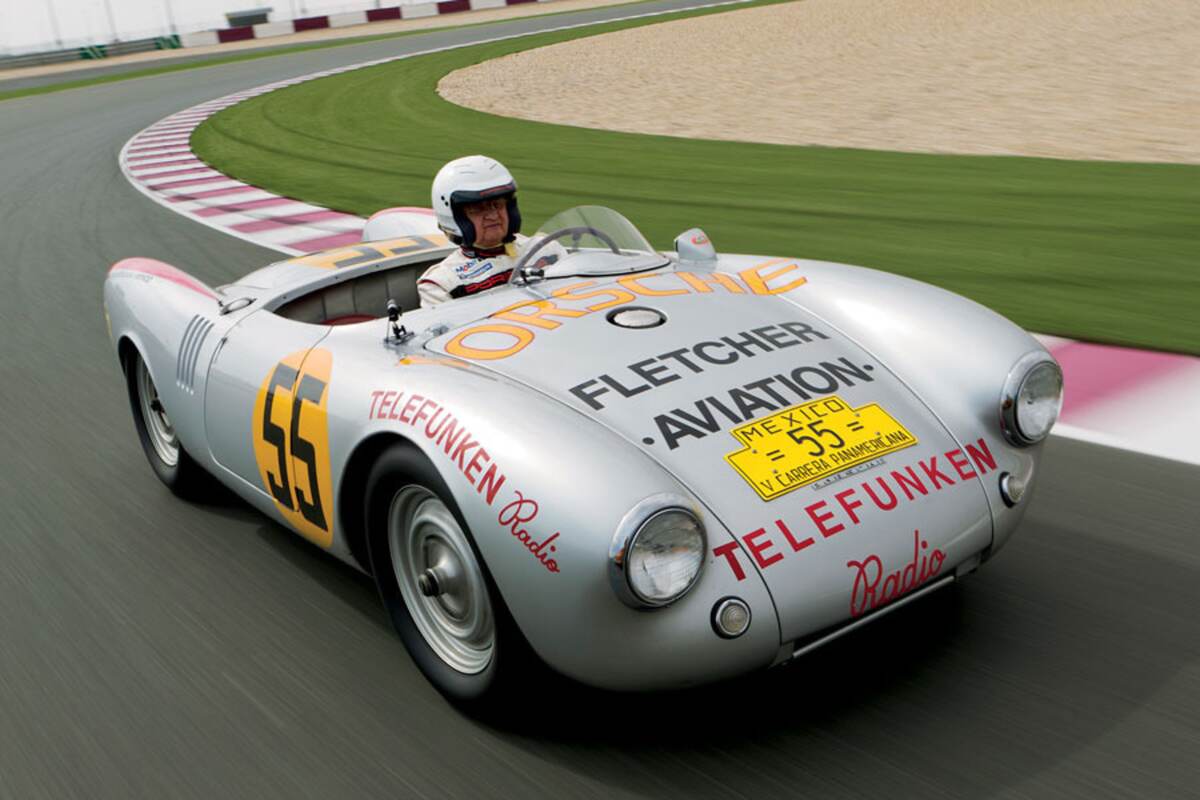
“Don’t lean against the door in a turn — it will come open and you will fall out!” That warning from Achim Stejskal, director of the Porsche Museum back in Stuttgart-Zuffenhausen, becomes urgent as we enter the second turn.
As the 550 Spyder glides through the bend, Hans Herrmann accelerates onto the front straight at Losail International Circuit just north of Doha, the capital city of Qatar. Losail, seen from the air, resembles a right hand attempting to make the Vulcan greeting salute from a Star Trek episode, palm outward. The first right hairpin curls around the thumb and the second turn, a left-hander, doubles back toward the distant index finger.
With no seatbelts in the car — its perfect restoration is period-correct — my fingers claw at anything they can find to avoid that door. Herrmann, of course, has the steering wheel to hold onto, which he twists and turns precisely, almost delicately, relying on muscle memory accumulated during thousands of hours spent testing and racing these cars a half century ago.
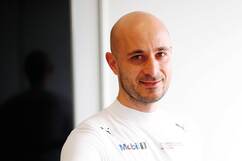
Herrmann is 82 now, yet he still has an agility about him. His face is a bit softer, a bit rounder than in his former racing days, and his multi-layer Porsche Motorsports driving suit hugs him. He’s driving Porsche AG’s Fletcher Aviation-sponsored Spyder 550-04, a car in which he finished third overall and won the 1500-cc class at the Carrera Panamericana in 1954.
Today, we’re a world away from Mexico. The track is wet, this despite the fact that locals say it only rains 19 days a year in Qatar. The 550 dances into turns but squats and digs in from the apexes out. It’s as sure-footed as its driver is self-assured. If you are allowed just one ride in a 550 Spyder in this lifetime, you want it to be in this car with this man at the wheel.

The circuit at Losail is as flat as Qatar, meaning flat. The second from last corner is a 180° right-hand opening onto a straight that sets you up for the circuit’s fastest bend before the long start-finish straight. As we sweep through, we’re close to 160 km/h. Herrmann is grinning, his hands steady on the wheel, as Ernst Fuhrmann’s Carrera four howls. Arcing through this bend at nearly full speed, we can see the grandstands in the distance. Herrmann keeps his foot to the floor through Losail’s last fast corner.
The bark behind our heads, from Fuhrmann’s insistent four-cam flat four, makes conversation impossible. The car throbs with its pulse. As Herrmann lifts off the accelerator, it’s as though the car takes a breath before its grunt and growl resume. When he raced these cars in Italy, Porsche fitted a windscreen to protect driver and riding mechanic. But this is a Carrera car, run without a passenger, so it has the correct, narrow protection in front of Herrmann alone — leaving the full force of 120-, 160-, 180-km/h wind working to peel the helmet off my head.
A lap of Losail, with its nearly alternating lefts and rights, scarcely hints at the potential and challenges of 1954 racing technology. The riding mechanic/navigator in those days may have had superior door-latch mechanisms — but still no seatbelts. In many events, the crucial road book detailing their route filled his lap, his attention, his hands. He rode with his head bobbing up and down, looking for landmarks and matching them to his notes made from trial runs weeks earlier.
When we’re 300 feet away from the pit entrance, Herrmann swerves his old race car in. As we pass the first pit box, he cuts the engine. The only noises left are the wind and the tires sluicing moisture off the pavement. An instant later, the engine backfires. One loud pop echoes off of the garage doors alongside us. As we coast to a halt, I release my deathgrip from Herrmann’s seat rail and inadvertently bump the door. It holds fast.
Could I have leaned against that door and flown out, rolling across rain-blackened tarmac into the Qatari desert, you ask? Surely not with Hans im Gluck! “Lucky Hans” was the nickname that Herrmann earned in the 1950s, when he survived countless crashes. His most famous came during the German Grand Prix in 1959. It was captured for all time in a photograph by motorsport photographer Julius Weitmann, which showed Herrmann sliding along the pavement at Avus Circuit outside Berlin.

Herrmann’s BRM Formula One racer lost its brakes and hit rain-soaked hay bales, launching him into the air. The car rolled twice, ejecting Herrmann along the way. In Weitmann’s photo, his BRM was nose up in the air — flinging parts and fluids to the four winds. A wheel and tire hovered in the air ten feet or so above his head. When everything came to rest, he walked away, merely bruised.
While many focused on Formula One in the 1950s, Porsche invested heavily in long-distance competitions. The company believed that endurance events tested and helped to further develop its cars’ chassis, bodies, and running gear — and it knew its performance in them inspired buyers.
Open road courses with few rules and less protection for participants or spectators were the greatest tests, and Herrmann became a master of two of the most significant events: the Carrera and the Mille Miglia, that 1,000-mile lap of Italy that went from one side of the Piazza della Vittoria in Brescia to the other by way of Rome, 280 miles to the south as the crow flew.
Racing historian and nine-time Mille Miglia entrant Giovanni Lurani has suggested Porsche was among the first entrants to provide its drivers with a route book. “In 1952,” he wrote, “the official Porsche team was supplied with a navigational aid that showed such landmarks as houses, petrol stations, and [billboards], enabling the driver to recognize certain corners.” While it wasn’t fully successful at first, subsequent scouting and practices, known as “training periods,” filled in blanks more accurately and with greater detail.
The training sessions became their own events. Drivers seldom practiced the entire length but instead travelled at two-thirds racing speed along various legs. The entrants planned these distances carefully, timing their arrivals to meet invitations for lunch and some wine with friends and fellow racers, or to pay respects to Ferrari or Maserati factories. But Lurani was quick to point out that, “the training for the race was not only a gastronomical and enological tour. The useful was combined with the delightful and we ended up knowing the long and difficult course well enough to compete it safely at speeds considered fantastic by the general public.”

All of Italy embraced the Mille Miglia, first run in 1927. With no idea how long it would take to cover a thousand miles, inaugural contestants packed suitcases with clothes for three days. The winner returned to Brescia barely 23 hours after he started. By the 1950s, as the speeds of competition cars exceeded 150 mph, organizers worked to ensure the circuit was closed, free from other traffic.
While the organizers interrupted the Mille Miglia during World War II, a legacy of that war and one of Benito Mussolini’s contributions to daily Italian life would continue to regularly interrupt the Mille. The Italian rail system would also become a special entry in Porsche’s road books. Herrmann remembers one train crossing on the Mille better than any other.
“The story starts with the fact that, in Italy, the trains run mostly on time,” he explains as he sits in the quiet of Losail’s pit garages. “There are security people (who) take care of the crossing gates. In normal times, they sometimes close the gate 15 minutes prior to the arrival of the train. They don’t know exactly what time the train will go through their crossing.”
Herrmann apologizes for his English, then enlists Stejskal as his translator. “During the race,” he continues, “they try to close the gates as late as possible, sometimes even as they see the train arriving! It’s to be fair to the racers, to not give anyone an advantage over the others. So the idea was always to close at the last second and open as soon as the train passes.
“But it’s important to know this: All the train crossings are different,” says Herrmann. “At some, the rails are right even with the road — smooth. At some, the rails are 10, 15 centimeters [roughly half an inch] above the road. In some, it was much higher, and this was very dangerous. So we included notes about these in the ‘bible,’ the ‘road bible,’ and the co-driver must be carefully reading this all along the route.”

His co-driver for the May 1954 Mille Miglia was factory mechanic and test driver Herbert Linge. Recalls Herrmann: “‘You must go slow here,’ the bible would say. But there were others where we could go fast. And we marked all these in Herbert Linge’s bible. We were on the road inland from Pescara, heading toward Rome, 160 kilometers away.” Pescara was the farthest southeast point of the route, which had clung to the Adriatic coast for about 200 km before turning inland. Herrmann and Linge had begun to climb the hills up from the shoreline toward the town of Chieti, an old Roman city complete with theater and temples from the 6th Century B.C.
“In this area, the bible was marked that this was a smooth crossing,” remembers Herrmann. “We did 160, 180 kilometers per hour — really full speed. Herbert Linge showed me the green card.” In an age before closed helmets and two-way radios, the pair had developed a system that didn’t rely on yelling. “We communicated only with green, red, and yellow cards. The bible was more or less the road book for the ‘special’ occasions, where the road was narrow or the turn was dangerous or a railroad crossing was high. Those times I got the red card. In this case, the crossing was safe. Then we did full speed.
“This was the train track from Pescara to Rome,” continues Herrmann. “It was a track for the express train. It was mountainous, hilly on either side of the road. We couldn’t see where the road went — we could only trust Herbert Linge’s bible. There was no possibility to see ahead from the road. The car is very low. The hills were high. At crossings like this, there was an official who was further back up the road, away from the crossing. He was there to warn us with a flag if the crossing was open or closed. But this official was standing behind the closure, not where he should be. And this is the reason Herr Linge and I did not see the crossing…. To be honest, there was no way to stop anyway. We were doing 180 km/h, and I saw no train!”
Herrmann says Linge had his head down, reading his bible — looking for the next note, the next cue for the next colored card. “I pushed him on the head, the back of the head, to push him down,” says Hermann. “I leaned down and we went under the gate. We missed the train by a few meters, a few meters only. I just heard it behind me.”
In another interview two years ago, a writer asked Herrmann about the train-crossing and wondered aloud if Herrmann thought his driving had been reckless? Others have questioned for decades the madness and daring of racing a train just to gain another place, one more trophy.
He wasn’t the first to wonder that. The Mille Miglia lasted just three more years after Herrmann’s and Linge’s harrowing drive. Speeds had risen to such an extent that the winners could cover the 1,000 miles in 10 hours and a few minutes. The number of cars running the event had changed, too, from 77 the first year to 374 in 1954, when Herrmann and Linge finished sixth overall and first in class with a time of 12 hours, 35 minutes, 44 seconds.
Umberto Maglioli, driving solo in a 550 RS Spyder, finished fifth overall in 1957. He needed 80 fewer minutes to cover the distance, doing it in just 11 hours, 14 minutes, and 7 seconds. His triumph was tempered by a bad crash just 25 miles from the finish, one that killed a Spanish driver, his English navigator, and ten spectators. Overnight, the daily newspapers that had covered the races and the Italian Parliament that had passed laws to enable it became vocal opponents. The Mille was finished.
“There are paintings of this train crossing,” says Herrmann, helmet off, sipping some water almost six decades later. He alternates between German and English, leapfrogging ahead of Stejskal’s translations, anxious to have this story understood.
“One is completely wrong,” he says. “It shows the countryside is flat. Well, if it had been, I would have seen the train and I would have reacted. The correct painting even shows the crossing official. He is jumping out of the way. He was supposed to be 100, 150 meters back up the road. To warn us. But there he was. If he didn’t jump, we would have hit him. We all had a lot of luck.”